

What you need per platform
After you deploy the prerequisites, each employee should open Granola and confirm Settings > Preferences > Speaker tags shows Enabled for each platform they use. See After deployment below.
The same Chrome extension and macOS Accessibility permission are also used by Granola’s transparency features. If you are already deploying those, you may not need separate steps.
Google Meet
macOS Windows Google Meet speaker tags work through the Granola browser extension. Each employee needs the extension installed in the same Chrome or Chromium-based browser profile they use for Google Meet. You can deploy it automatically via Google Admin to your entire organization, or scope it to specific teams using Organizational Units (OUs) or Google Groups.Install the Granola Chrome extension
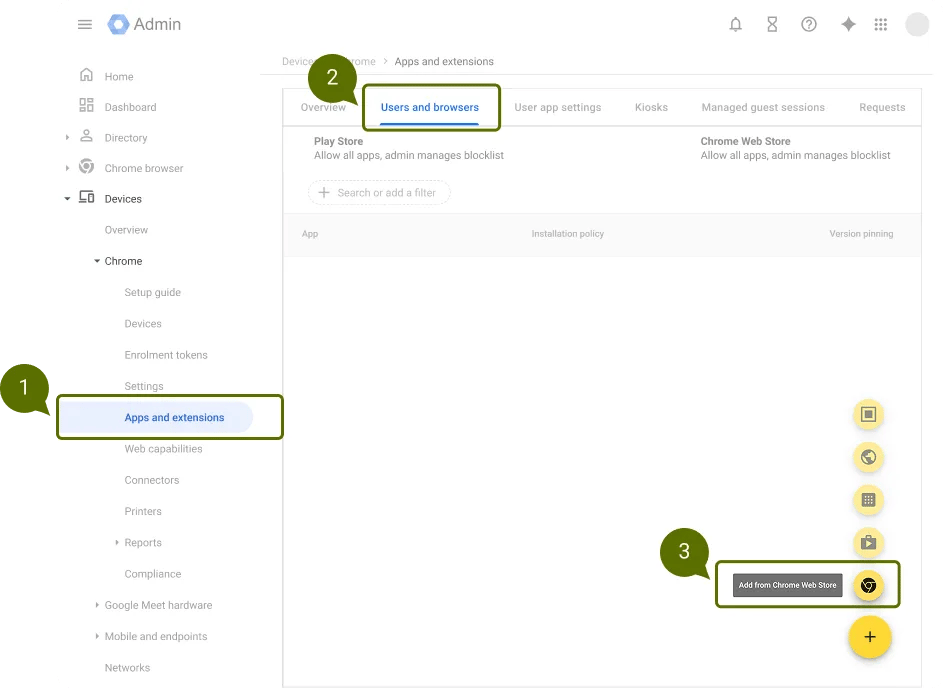
- Sign in to your Google Admin console.
- Go to Devices > Chrome > Apps & extensions > Users & browsers.
- Click the + (plus) button in the lower right corner and choose Add from Chrome Web Store.
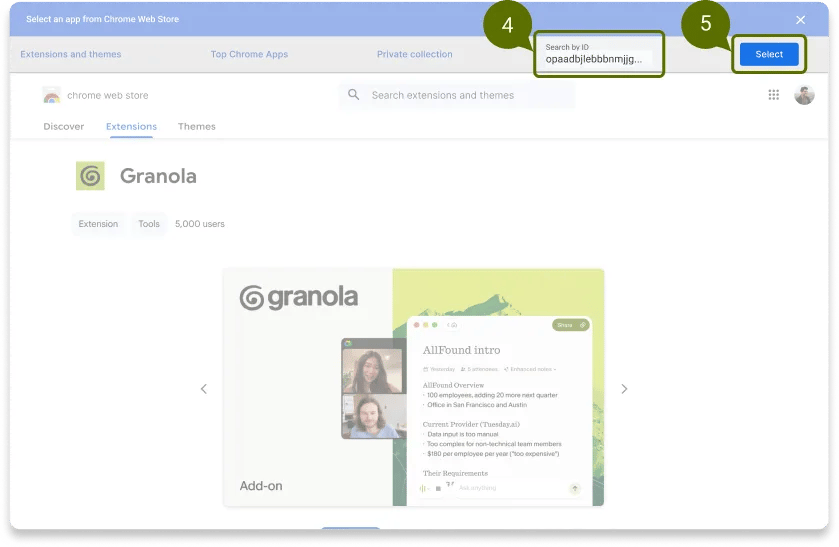
- Click Search by ID in the upper right and paste the extension ID:
opaadbjlebbbnmjjgdmdllingedoleml - Click Select to add the Granola extension.
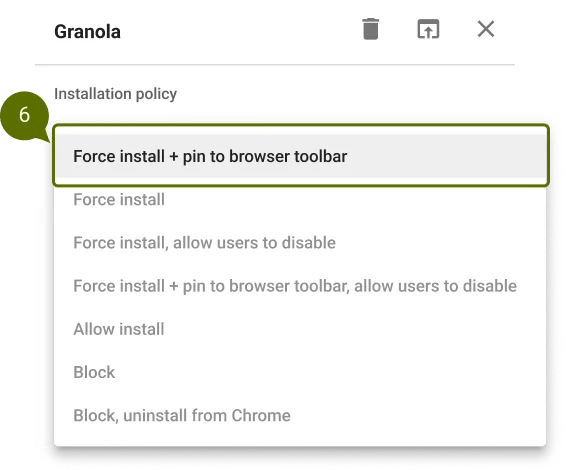
- Set the installation policy to Force install or Force install + pin to browser toolbar to ensure consistent deployment across your organization.
Scope installation to specific users
By default, the extension applies to your entire organization. To limit it to specific teams, departments, or locations:Option 1 — Organizational Units (OUs)
Option 1 — Organizational Units (OUs)
Organizational Units let you group users by department, location, or any other criteria and apply policies to each group independently.
- In the Google Admin console, go to Directory > Organizational units.
- If you don’t already have an OU for the target group, create one.
- Move the relevant users into that OU.
- Go to Devices > Chrome > Apps & extensions > Users & browsers.
- In the left sidebar, select the OU you want to target (instead of the top-level organization).
- Add or configure the Granola extension for that OU. Only users in the selected OU will receive the installation.
Option 2 — Google Groups
Option 2 — Google Groups
If restructuring your OUs isn’t practical, you can target installation via a Google Group instead. This is useful when users span multiple OUs (e.g., a cross-location team).
- In the Google Admin console, go to Directory > Groups.
- Create a new group (or use an existing one) containing the users who should receive the extension. For example,
granola-users@yourcompany.com. - Go to Devices > Chrome > Apps & extensions > Users & browsers.
- In the left sidebar, search for and select the group you want to target.
- Add or configure the Granola extension for that group. Only members of the group will receive the installation.
The extension requires Google Chrome or another supported Chromium browser (Edge, Arc, Brave). Automated force-install through Google Admin applies to Google Chrome; users on other supported browsers may need to install the extension manually from the Chrome Web Store.
Zoom (macOS)
macOS Zoom speaker tags use the Zoom Workplace desktop app and require macOS Accessibility permission so Granola can read participant display names and the active-speaker indicator from Zoom. They do not use the Granola browser extension. Each user must grant Accessibility permission to Granola. On managed Macs, you can pre-grant this via MDM so users never see the permission prompt.About Accessibility access
Accessibility is a macOS system permission that allows apps to read interface elements in other apps. For Zoom speaker tags, Granola uses it to read participant names and the active-speaker indicator shown in the Zoom desktop app. Speaker tags do not use Accessibility access to record your screen, capture audio, or access your camera or microphone.Auto-grant via MDM
Accessibility for Granola can be pre-granted on managed devices so end users never see the macOS permission prompt. The grant is delivered as a Privacy Preferences Policy Control (PPPC) profile pre-approving Granola (team IDQZ7DHHLN25, bundle ID com.granola.app) for the Accessibility service. Below is an example .mobileconfig you can use directly, or adapt as a starting point.
allow-granola-accessibility.mobileconfig
allow-granola-accessibility.mobileconfig
Zoom (Windows)
WindowsZoom speaker tags are not currently available on Windows. Employees on Windows will see Me and Them in Zoom transcripts until Windows support is released.
After deployment
Once you have deployed the extension and/or Accessibility permission, ask employees to:- Open the Granola desktop app (updated to the latest version).
- Go to Settings > Preferences > Speaker tags.
- Confirm each platform they use shows Enabled:
- Google Meet — connects automatically once the extension is installed in their browser profile.
- Zoom — may require clicking Set up next to Zoom the first time, even if Accessibility was pre-granted via MDM.
FAQs
Does the browser extension access meeting content?
Does the browser extension access meeting content?
For speaker tags, the extension reads active-speaker and participant-name data from Google Meet. It does not access meeting audio, video, or transcripts. (If your workspace also uses Google Meet transparency features, the same extension can send the automated chat notice.)
Which browsers are supported for Google Meet?
Which browsers are supported for Google Meet?
The browser extension requires Google Chrome or another supported Chromium-based browser (Edge, Arc, Brave).
Do I need a separate setup for transparency features?
Do I need a separate setup for transparency features?
The Chrome extension and macOS Accessibility permission are shared with Granola’s transparency features. Deploying them for speaker tags also satisfies those prerequisites. Transparency features have additional workspace settings and, for Google Meet, a pinning configuration — see the admin transparency guides.